
Best Pest Control Software
Where Dream Fits in the Best Pest Control Software Comparison
Best pest control software means one thing above the feature list: do sales and the back office run off one record, or off two reconciled by hand. Dream Service Software compares the mid-market pest control software field below for one kind of operator: $10-100M revenue, 80-700 field technicians. Most roundups of pest control software put a two-truck operator's app next to an enterprise platform in the same list, which tells a mid-size operator almost nothing.
Five vendors make up the rest of the evaluation set a mid-market operator actually faces: PestPac, FieldRoutes, Evolve, Briostack, and ServSuite. We put Dream through the same three tests we tell you to put to anything else you evaluate: does sales share one record with the back office, who owns the company, and what happens to the bill as you grow.
Key Takeaways
- Which pest control software is best depends on operator size. The scope here is mid-market: $10-100M revenue, 80-700 field technicians.
- The decision that outranks every feature checkbox: whether sales and the ERP back office run on one customer record, or on two systems someone reconciles by hand.
- Dream is the only platform in this set built as one customer record across sales, back office, and compliance, from one founder-owned company.
- Ownership structure is a real decision factor. Evolve was recently acquired by private equity; Dream has stayed founder-owned since 2012.
What counts as the best pest control software for a mid-market operator?
Pest control software, at the mid-market tier, covers three overlapping jobs that vendors bundle differently. Sales and estimating fall to the CRM. Scheduling, billing, and the back office fall to the ERP. Compliance covers WDO/WDI inspections and pesticide-application records. Three jobs. Point tools cover one of the three. An operator asking which platform is best is almost always comparing full platforms across all three. At this size, the pain is systems that don't talk.
Dream's own pest control CRM and pest control ERP share one record for exactly this reason. When sales, dispatch, and billing all read from that one record, nobody spends Friday reconciling three exports that stopped agreeing on Tuesday.
The mid-market comparison set: who Dream competes against
A $15M operator running 120 techs and a $40M enterprise account are not shopping the same list. Everything here stays in the mid-market band on purpose, because a list that spans solo operators through national accounts ends up generic enough to be useless to either end. At $10-100M revenue and 80-700 field technicians, the real evaluation set is six vendors: Dream, PestPac (WorkWave), FieldRoutes (ServiceTitan), Evolve (EvolveOne), Briostack, and ServSuite. All six show up in the same RFPs and the same PestWorld conversations. The rest of the comparison is how Dream stacks up against the other five, test by test.
Pest control CRM vs ERP software: the architecture question that decides this
Every vendor in this comparison will tell you it "does CRM and ERP." On paper, almost all do. What separates them: one shared record, or two reconciled by hand.
One record vs. two systems reconciled by hand
The real difference between the five vendors isn't the feature list.
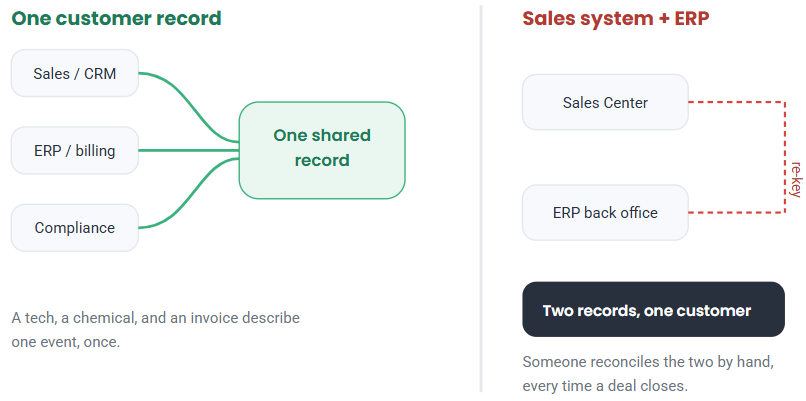
Most platforms in this market grew up as one half of the job. Either a back office that later added a sales module, or a scheduler that later added marketing. Both roads end at the same place: the sales system and the ERP run as two products, sold as two licenses, kept honest by an integration someone has to maintain. That cost lands on a person, usually in ops or accounting, who re-keys or reconciles the same deal twice, and on a sales manager who can't pull close rate by source and rep without an export. One operator who had just been through a platform switch put the result flatly: "office/tech/sales are all different so no one is on the same page" (r/PestControlIndustry).
Dream never split the record. Its CRM, ERP, and compliance were built reading and writing the same account. Pest control management software and billing work against the account the sales rep opened, so the close-rate report and the AR aging describe the same customers, no export in between.
How Dream compares to PestPac, FieldRoutes, Evolve, Briostack, and ServSuite
Nobody in this market publishes a rate card a buyer can act on. One operator wrote, the day before a vendor demo: "the rep that set up the demo couldn't give me info on pricing until after the demo" (r/PestControlIndustry). Dream prices the same way every vendor here does, quoted against your technician count and product mix on the demo call, never off a published tier. So read the pricing notes below as a description of how each vendor charges; the number itself only exists on a call.
| Tool | What it really is | Best for | Where it falls short |
|---|---|---|---|
| Dream | Pest-native CRM and ERP on one record, three products (Sales CRM, ERP, Dream Pulse) available separately or bundled | Mid-market operators wanting sales, back office, and compliance on one account, still founder-owned | Quote-based pricing rather than a public rate card; built for $10-100M operations, more platform than a smaller shop needs |
| PestPac (WorkWave) | Pest-native ERP with a separately licensed Sales Center, state-form library, Sentricon integration | Large and commercial operators who need PestPac's state-form library and 500+ integration catalog | Sales Center and ERP are two systems to keep in sync; per-module pricing and a multi-year contract are the norm |
| FieldRoutes (ServiceTitan) | FSM with sales/marketing tooling and visual routing, owned by ServiceTitan | Mid-to-large residential operators who weight the sales funnel and door-to-door motion highest | Runs pricier than peers, with SMS and card-processing surcharges reported by users; compliance is a module inside a scheduling-first platform, and the back office is a connected but separate system |
| Evolve (EvolveOne) | Pest-native FSM, recently acquired by private equity | Mid-market residential shops wanting hands-on onboarding support | Ownership just changed hands; a PE owner's priorities differ from a founder-owner's |
| Briostack | Pest FSM with a mobile app, built around route density | Residential route-density operators who weight field-completion speed highest | Field work and scheduling lead the product; compliance and back-office depth trail the ERP-first platforms |
| ServSuite | Legacy pest ERP, now part of the FieldRoutes/ServiceTitan family | Operators already running an established ServSuite install who value stability over a rebuild | Owned by the same company that also sells FieldRoutes; the interface predates the current generation of platforms |
Read the table column by column and one pattern holds: every other row either splits sales from the back office or trails on compliance depth, and four of the five answer to a corporate or private-equity owner. Only one row runs sales, back office, and compliance on a single record with the roadmap answering to the founder who has run it since 2012: Dream's. That's the comparison to test live, in a demo, on your own account data.
Looking for a PestPac alternative or a FieldRoutes alternative? Start here
Most operators who leave PestPac or FieldRoutes were fine with what the software did day to day. Cost is what moves them. A sales add-on, billed separately from the ERP. A contract that locks in the full term. An invoice, billed per module, that grows every time the business adds a capability. What actually de-risks a PestPac or FieldRoutes migration is a unified CRM on top of the ERP data already in place, with the back office moving over on its own timeline until both run on the one record. It skips the full rip-and-replace on day one. That's the PestPac alternative path Dream runs with mid-market operators today.
How do you choose the best pest control software for your operation?
A feature checklist tells you what a platform handles this quarter; these questions predict whether it still fits in three years. Dream's demo answers them up front. If you look at anything besides Dream, be sure to ask them these.
- Does the sales system and the ERP share one customer record, or does someone reconcile two versions of the same deal by hand?
- Who owns the company, and did that change recently? A roadmap under new private-equity ownership answers to a different clock than a founder-owned one.
- Is pricing modeled per module, or per account? Ask what happens to the bill the next time you add a product, a branch, or a technician.
- What's the actual contract term, and what does early exit cost? Get this in writing before the demo ends, not after.
- Does compliance reporting (WDO/WDI, pesticide-application logs, state-specific forms) live inside the CRM/ERP record, or in a separate module you access on its own?
- If the vendor was acquired recently, ask what the acquisition changes for the product you're buying, its pricing, and its support, and get the answer in writing.
- Ask to see the mobile app run a real job, live, not a slide. Field-completion speed is the difference technicians actually feel every day.
- Can the vendor show you a CRM and ERP working off the same account in the demo, with your technician count and product mix, not a generic script?
FAQ
What is the best pest control software for a mid-market operator?
There is no single best pest control software for every operator; the right choice depends on technician count, whether sales and the ERP need to share one record, and how much weight you put on compliance depth versus sales/marketing polish. For pest control software for mid-size companies, meaning a $10-100M business running 80-700 technicians, the real evaluation set is PestPac, FieldRoutes, Evolve, Briostack, ServSuite, and Dream.
What's the difference between pest control CRM, ERP, and field service management software?
CRM covers the sales and estimate process. ERP covers scheduling, billing, and back-office operations. Field service management is the broader umbrella both fall under. What matters in practice is whether a vendor runs CRM and ERP as one connected record or as two separate systems.
Is PestPac or FieldRoutes better for a growing pest control company?
Both are established platforms, and both separate the sales system from the ERP back office, so an operator choosing between them is choosing which split system to reconcile. Dream removes that choice: sales and the back office run on one customer record. Test all three in a demo against the same account data.
Is ServSuite still a good option for a mid-market pest control company?
ServSuite runs established installs, and operators already on it face a rebuild cost to leave. It is now owned by the same company that also sells FieldRoutes, so before recommitting, ask what that ownership means for the product you're on, and compare the answer against a platform with one product and one owner.
Does it matter if a pest control software vendor is owned by private equity?
It can. A PE-owned vendor's roadmap and pricing priorities answer to an investor return timeline. That isn't automatically bad, but it's a different set of incentives than a founder-owned company managing its own long-term roadmap. Evolve recently changed to PE ownership; by contrast, Dream has stayed privately owned and founder-led since 2012.
What questions should I ask before switching pest control software?
Ask whether sales and ERP share one record, what the actual contract term and exit cost are, how pricing changes as you add products or technicians, and whether compliance reporting lives in the core record or a separate module. Ask who owns the company today, and whether that ownership changed in the last two years. Get every answer in writing.
Can I run pest control CRM and ERP as one platform instead of stitching two systems together?
Yes. Dream runs Sales CRM and ERP on one shared customer record. No separate systems to reconcile. Both are available on their own, or bundled with Dream Pulse as three products on one platform.
A mid-market shortlist comes down to two facts about each vendor: whether sales and the back office share one customer record, and whose roadmap stays pointed at this product for the next three years. Dream runs one record, under one founder-owner, since 2012. If you evaluate anything else, get its answer to both in writing during the demo.
See Dream running on your own numbers
Bring your technician count and product mix to the call. You'll see everything run on your own data.
If Dream isn't a fit for your operation's size or mix, we'll say so on the call.