Pest Control Billing Software
Pest Control Billing Software: Recurring Billing, Autopay, and AR Compared
Pest control billing software is the system that turns finished service into collected cash: it charges recurring plans on schedule, runs payments by card and ACH, retries the cards that fail, and ties every invoice to the route and the chemical record behind it. That last job is the one generic invoicing tools cannot do, and it is where mid-market operators lose the most revenue. A tool that bills a job is easy to find. One that knows the job was a quarterly account, serviced Tuesday, on autopay, with a state-required pesticide record attached, is a different category, and it is the one this guide is about.
If you run a $10M to $30M pest operation, most of your revenue renews on a card no one in the office ever looks at. A failed charge that nobody catches costs you real money. Across subscription businesses, failed payments cause 20% to 40% of all customer churn, and the declines pile up every cycle as cards expire, get reissued, or trip a fraud flag. A renewal that lapses because nobody retried a dead card costs more than a missed invoice. That customer would have paid you for a decade, and the lapse loses them with no report flagging it.
Full disclosure on who is writing this. Dream Service Software builds the pest control CRM and ERP, developed since 2012 in close partnership with working pest operations, and it is operator-built and still founder-owned, with no private-equity clock. Billing is where we have watched mid-market shops lose the most revenue, so this guide is opinionated, and it gives the competitors that bill well their due.
What pest control billing software actually does
Pest control billing software automates invoicing, payment collection, and accounts receivable for a business that sells recurring contracts, not one-time jobs. Billing sits on the pest control ERP side of the platform: plans, payments, and the accounting sync. Six jobs separate it from a generic invoicing app.
- Recurring billing on its own cadence. A quarterly plan invoices every three months, a monthly plan every month, with nobody remembering to send it.
- Autopay with tokenized payments. Cards and bank accounts are saved once as secure tokens and charged the day service runs, by card or ACH. This is what pest control payment processing means in practice.
- Failed-payment dunning. When a charge declines, the system retries on a schedule and texts the customer to update the card. Most of the revenue you recover comes from this step.
- Route-based billing. The invoice generates when the tech completes the stop, so the bill matches what was serviced and when.
- AR aging tied to the service. A 30/60/90 view shows what is owed and which route or rep it came from, so collections is targeted rather than guesswork.
- Compliance on the invoice. The pesticide applied is documented on or beside the charge, so chemical compliance travels with the bill, because in most states that record is not optional.
Done right, a pest billing system does all six on one customer record. Generic tools do the first one, roughly, and leave you to add the rest separately.
Can you use pest control accounting software like QuickBooks?
You can, and plenty of small shops do, but you will pay for it as you grow. Pest control billing software and pest control invoicing software are one category from two angles: billing is the recurring engine, invoicing is the document it produces. QuickBooks, Wave, and FreshBooks are capable pest control accounting software for the books. None was built for a route-based subscription business, so three gaps open fast.
Recurring service does not map to their model. They invoice on a date, not on a service plan, so applying a prepay discount or prorating a mid-term upgrade becomes manual work every cycle. They cannot see the field, so the invoice never reflects that a Tuesday stop moved to Thursday. And they handle a failed charge by logging it once, which means an expired card sits as an open invoice until someone notices at renewal. For a one-truck operator sending a few invoices a month, that is fine. For a 90-truck book running thousands of recurring stops, it leaks.
There is a bigger structural problem, and it usually surfaces only after the others. When your sales and service live in one system and your billing lives in QuickBooks, a CSR keys every closed deal twice, and the two records drift apart the moment one is edited and the other is not. That is the two-system tax, and it gets its own section below.
The best pest control billing software: how the tools compare
There is no single best pest control billing software, because a solo operator with 300 accounts and a commercial shop with 700 techs are not buying the same thing. Treat the prices as rough bands, not quotes. Most of these vendors price by custom quote and bill setup, payment processing, and add-on modules separately, so the only number that matters is your own line-itemed quote.
One deal, three stages. The breaks all sit on the seams between them
Sell
CRM
Lead, quote, e-signature
Close the recurring plan
Who: sales, office
Service
FSM
Route, dispatch, tech app
Chemical record on the stop
Who: techs, dispatch
Bill and collect
ERP
Recurring charge, autopay
AR, dunning, accounting
Separate system: cannot see sale/service
1. Re-entry
A CSR retypes every closed deal
into the billing system, 8 to 12
fields a deal.
2. Broken AR
Past-due balances can't tie
back to the route, rep, or
service. Collections is guesswork.
3. Silent leakage
Failed cards never retried,
renewals lapse, prepay never
applied.
| Tool | What it really is | Recurring + autopay | Failed-payment dunning | Best for | Rough price band |
|---|---|---|---|---|---|
| ✅ Dream | Pest-native CRM and ERP on one record | Yes, route-triggered | Yes, retry + portal recovery | Mid-market wanting the sale, service, and billing on one record | Mid-market, quote-based |
| PestPac (WorkWave) | Pest-native ERP, deep back office | Yes | Yes | Large and commercial operations | Quote, ~$150/user/mo+, add-on heavy |
| FieldRoutes (ServiceTitan) | FSM + billing for scaled operators | Yes, route-triggered | Yes | Mid-to-large residential at scale | ~$2.5–3K/mo and up, surcharged |
| Evolve (EvolveOne) | Pest-native FSM, recently PE-acquired | Yes | Yes | Mid-market residential; support-led buyers | Quote-based |
| Briostack | Pest FSM + billing, consumer app | Yes | Yes | Residential route-density operators | Mid-market, quote-based |
| ServiceTitan | Enterprise multi-trade platform | Yes | Yes | Large HVAC/plumbing-rooted operators | Enterprise, highest band |
| QuickBooks / Xero | Horizontal accounting | No | No | The books, beside a field system | ~$30–200+/mo |
A few honest notes. PestPac is the deepest back office on the list and what most large commercial shops actually run, and operators who have been on it for years will tell you it works. The complaint is rarely function. It is the add-on pricing and the support wait, which a long-tenured customer described to us as the product always seeming a step behind. FieldRoutes and ServiceTitan are built for scale and priced for it. Evolve carries a good support name with a lighter sales side. Briostack runs on residential route density. The smaller tools, GorillaDesk and Jobber, serve owner-operators under about ten trucks; that tier handles simple invoicing fine and starts to strain when recurring plans, failed-payment dunning, and commercial billing pile up.
Feature checkboxes barely move the real decision. Whether billing shares a record with sales and service, or sits beside it as its own system, decides the rest, and that is the next section.
Recurring billing software for pest control: how autopay and route-based billing work
Recurring billing software for pest control has to think in plans, not invoices, because the recurring base is the asset you are building. Service quarterly and bill monthly, or service monthly and bill annually with a prepay discount: the engine keeps the service schedule and the invoice schedule separate. Autopay then charges the saved token on the billing date, so a renewal becomes a non-event instead of a phone call. And route-based billing fires the invoice when the tech closes the stop on the mobile field app, carrying what was serviced and the chemical record, which means no batch data entry on Friday afternoon. Through the customer portal, customers update a card, view a statement, and pay online without calling the office.
What happens when the card fails
Almost no comparison page covers this part, and it costs the most. Cards fail constantly. They expire, hit limits, get reissued after fraud, or bounce on an ACH return. On a recurring book a meaningful share of charges fail every cycle for reasons that have nothing to do with the customer leaving. The industry calls it involuntary churn.
Good billing runs dunning against it: it retries the charge on a schedule, emails and texts the customer to update the card, prompts them through the portal, and escalates to the office only when automation is spent. By contrast, a generic tool charges once, logs the decline, and goes quiet, so the renewal lapses weeks later and nobody connects the two. The migration version is worse. Switching software, if the stored payment tokens do not carry over cleanly, makes every customer re-enter a card, which forces you to phone a loyal customer because you cannot find their payment information. Scope the token migration before you sign, and ask the vendor in writing what transfers and what gets re-collected.
The billing-side two-system tax
Trace the failed card back to its cause and you reach one structural problem. When the system that sells and services the job is separate from the system that bills and collects, the two never share a customer record, and recurring revenue leaks through the seam. It shows up three ways.
Re-entry: a CSR retypes every closed deal into the billing system, eight to twelve fields a deal, producing nothing that was not already typed once. Broken AR: the accounting tool shows a past-due balance but cannot tell you which route, rep, or service it came from, so the aging report cannot find the pattern. Silent leakage: the declines never retried, the renewals that lapse, the prepay never applied. Each is small and none shows up as a line item. Together they cost more than any line item on the software invoice, because billing has no view of the sale or the service.
A slicker integration between two separate systems does not fix this. Billing has to share one customer record with the sale and the service, so a payment ties to a route, a decline triggers a real workflow, and a renewal is visible before it lapses. That is the same one-record argument behind the pest control CRM decision, seen from the money side: CRM wins the deal and ERP bills it, and when both run off one record neither loses track of what the other did. It is why Dream is built differently, one record from handraiser to renewal instead of a separate billing tool kept in sync with the sales system by hand.
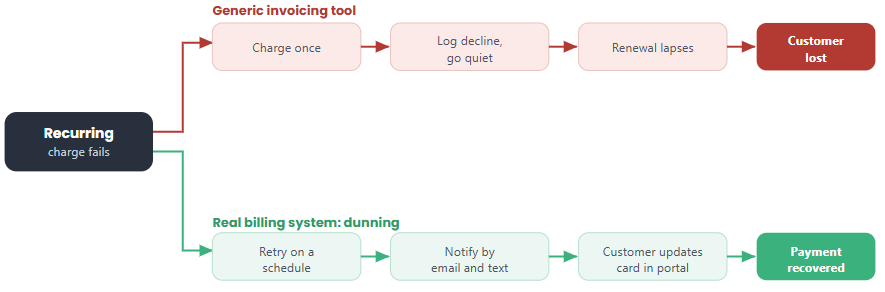
On a recurring book, a meaningful share of charges fail every cycle for reasons that have nothing to do with cancelling. The path you take decides whether that is churn or a non-event.
The recurring-revenue leak: failed card to lapsed renewal
How much does pest control billing software cost?
Pricing splits along the same line as capability. SMB field-service tools with billing built in run roughly $25 to $150 per month: GorillaDesk from about $49, Jobber from about $25, scaling with users and features. Accounting tools like QuickBooks sit in a similar band and solve a different problem. Pest-native and enterprise platforms (PestPac, FieldRoutes, Briostack, ServiceTitan, Dream) are quote-based and scale with technicians, revenue, and modules, so a mid-market operator should expect a four-figure monthly number once billing, compliance, and the field app are all included. Multi-unit and HOA billing usually lives in this tier too.
The number that matters is not the subscription. Look instead at the cost of the work the software removes: the CSR hours spent re-keying deals and chasing declines, and the recurring revenue that lapses when a failed card goes unnoticed. Software that ends the re-entry and automates dunning pays for itself in collected renewals long before the line item matters.
What should a pest control company look for in billing software? Questions to ask any vendor
Carry this into every demo. It separates a billing engine from an accounting tool wearing a pest logo.
- Does it bill recurring plans on a cadence separate from the service schedule, with prepay and proration handled automatically?
- Does the invoice generate when the tech completes the stop, carrying the chemical record? Ask to see route-based billing live, not on a slide.
- How does autopay store payment credentials, and are card and ACH both tokenized?
- What is the dunning workflow when a recurring charge fails? Retry schedule, customer notifications, portal self-service, office escalation. Vague answers here are where your revenue leaks.
- Can AR aging tie a past-due balance back to the route, rep, and service?
- Does it handle multi-unit, HOA, and commercial billing with consolidated invoices and audit trails? This matters for commercial accounts.
- How does it sync with QuickBooks or Xero, one-way or two-way, and where do I re-enter data?
- If I switch, what happens to my stored payment tokens? Confirm migration before you sign.
- Does billing share one record with sales and service, or sit beside it? This single question predicts whether you will pay the two-system tax.
- Who owns the company, and what happens to pricing and support if you are acquired? Pest software carries a heavy private-equity track record; ask who picks up when billing is down.
FAQ
What is pest control billing software? It is software that charges recurring pest control service plans on schedule by card or ACH, runs autopay and failed-payment retries, manages accounts receivable, ties invoices to the route and chemical record, and syncs to accounting. Unlike generic invoicing tools, it handles route-based and recurring billing built for a subscription field-service business.
What is the difference between recurring billing and one-time invoicing for pest control? One-time invoicing bills a job after it happens. Recurring billing charges a service plan on its own schedule, often different from the service schedule, with autopay, prepay discounts, and renewals. Most pest revenue is recurring, so the recurring engine is the part that decides whether the money collects itself.
Can I just use QuickBooks for pest control billing? QuickBooks handles the books well, but it has no recurring service model, no route-based invoicing, and no view of the field, so it sits apart from the system that sold and scheduled the job and gets re-keyed. Many operators keep QuickBooks for accounting and run billing in a pest-native platform that syncs to it.
How does autopay work for quarterly or seasonal service? The customer's card or bank account is saved as a secure token and charged automatically on the billing schedule you set, which can differ from the service schedule. Better systems also retry failed charges and prompt the customer to update an expired card before the plan lapses.
What happens when a customer's card fails on a recurring charge? Real billing systems run a dunning workflow: they retry the charge, notify the customer by email and text, and ask them to update the card in a portal, escalating to the office last. Weaker tools log the decline once and go quiet, which is how recurring customers lapse without the office noticing.
How much does pest control billing software cost? SMB tools with billing built in run roughly $25 to $150 per month and scale with users. Pest-native and enterprise platforms are quote-based and scale with technicians, revenue, and modules, typically landing in the four-figure monthly range for a mid-market operator once billing, compliance, and the field app are included.
Does billing software handle chemical-compliance documentation? Pest-native platforms tie the pesticide-application record to the service record that becomes the invoice, which keeps the state-required documentation attached to the account. Generic accounting tools do not, so that record has to live somewhere else.
Do I need separate billing and CRM software, or one system? You can run them separately, but then billing cannot see the sale or the service, which forces duplicate entry and breaks the link between payments and routes. On a platform where the CRM and ERP share one customer record, billing, collection, and renewal never lose track of what was sold or serviced.
Most operators compare billing tools feature by feature. The more useful question is this: can your billing system see the sale and the service it is billing for, or is it a separate tool someone keeps in sync by hand? Answer that, and the list of real options narrows fast.
So watch billing, service, and the sale run on one customer record for a real pest control account. Book a Dream demo: 30 minutes, bring one recurring account.